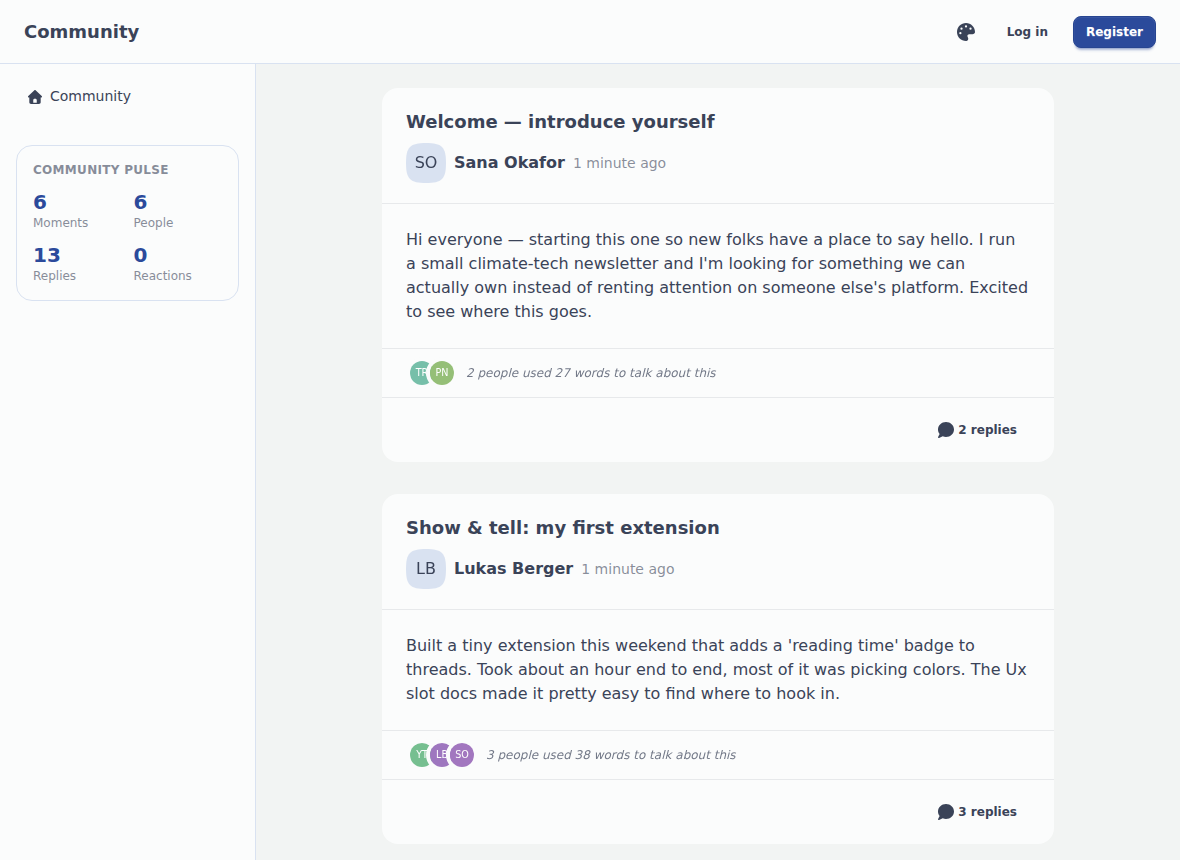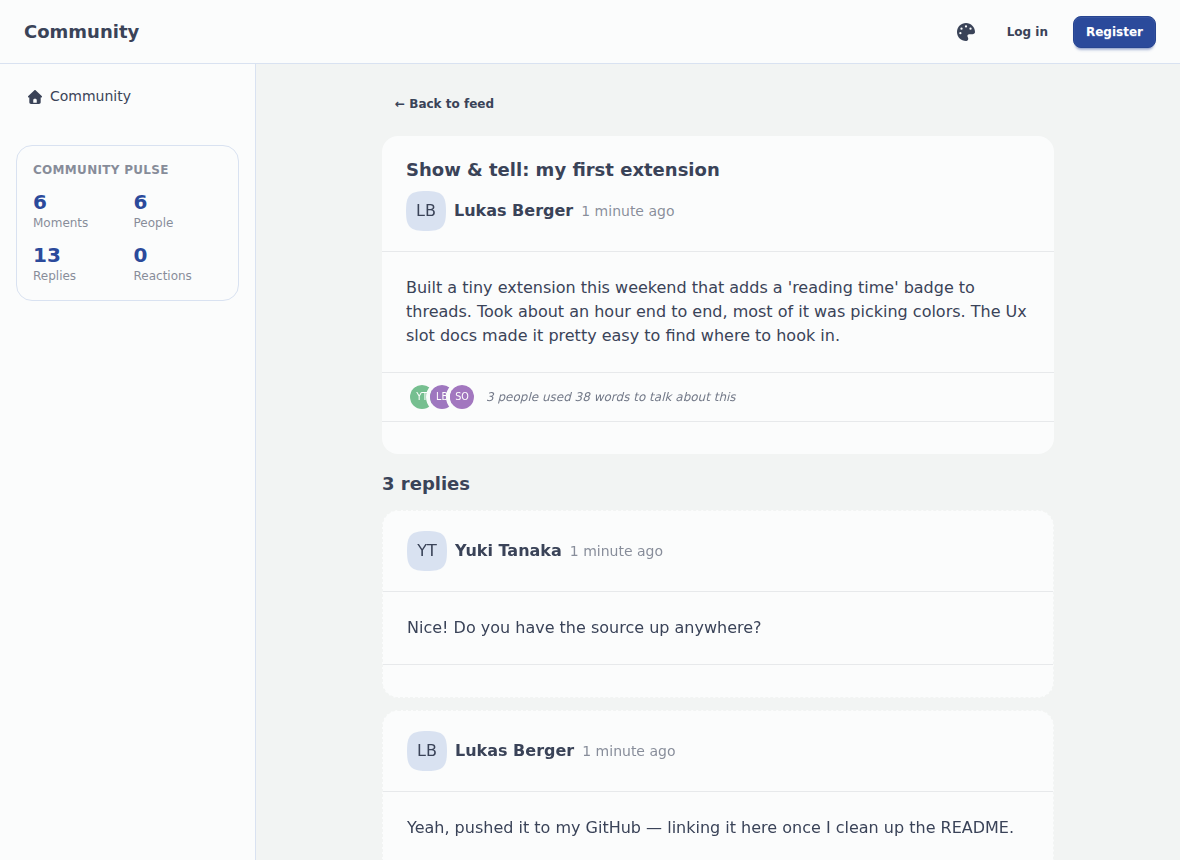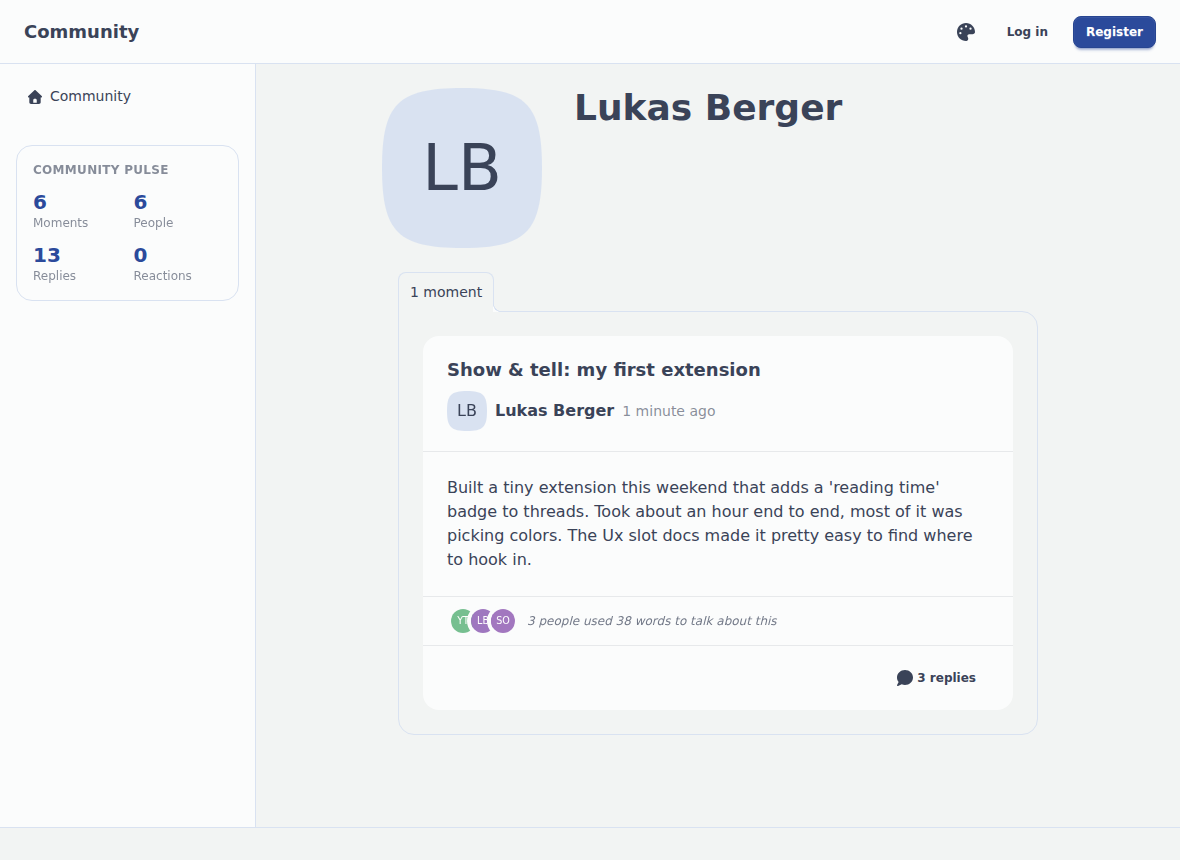
Open source · Federated · Mobile-first

Community software that engages.

Kopling is a new platform for communities that want to be involved now — sharing moments the second they happen, building a following from the first post, and keeping every conversation structured instead of scattered.

In development · by whom?

kop·ling from Dutch koppeling — clutch. The mechanism that connects and engages.
Principles

Five commitments, made before the first release.

These aren't features on a roadmap. They're constraints every technical decision below was tested against.

Open source

Yours to run, read, and fork

Free license, public development, and a governance model designed before the community arrives — not after.

Federated

Conversations across instances

Discussions federate as discussions — threaded, forum-shaped — over ActivityPub, following the trail Discourse and NodeBB blazed.

Mobile-first

Designed for the device in your hand

Server-rendered pages that are fast on weak connections, installable as an app, with push notifications from day one.

Immediate

Live by default

Replies stream in as they're posted. Share the moment while it's still a moment — no refresh button required.

Extensible

An ecosystem, not an afterthought

Extensions are PHP and templates — no build step, no frontend framework to learn, no upgrade roulette.

For every scale

Friend groups to enterprises

Runs modestly on modest hosting, shines on real infrastructure — and tells you plainly which mode you're in.

Specification

The stack, decided.

Most projects announce a vision. We're publishing the engineering decisions — and the reasoning — so you know exactly what you'd be building on, contributing to, or sponsoring.

Backend
PHP · Laravelfull framework, wrapped in Kopling contracts
The most widely known PHP stack there is. Extensions code against stable Kopling APIs, so framework upgrades never ripple through the ecosystem.
Frontend
htmx 4 + Blade + AlpineHTML over the wire
The server is the single source of truth. Interactivity lives in attributes, live updates stream over SSE and WebSockets, and there is no client framework for extension authors to learn.
Styling
Tailwind v4 + daisyUIbeneath a Kopling component library
A documented set of ready-made components — buttons, forms, modals — with accessibility and behavior built in. Admins re-theme at runtime; no rebuild, ever.
Editor
Tiptapstructured content, rendered server-side
Posts are stored as structured documents and rendered to HTML in PHP. Extensions add rich content types — polls, embeds — validated and sanitized on the server.
Federation
ActivityPubforum-shaped conversations
Threaded discussions federate as threaded discussions, compatible with the emerging forum federation work — not flattened into microblog posts.
Identity
UUIDv7 everywhereorigin-aware from the first migration
Time-ordered universal IDs keep massive databases fast and make every object addressable across instances. Remote content is a first-class citizen in the schema.
Extensions
Kopling registryComposer-compatible · kopl.ing
One official registry with machine-checked compatibility — core versions, database support, conflicts — surfaced before you install. Anyone can run their own.
Storage
Capability-based filesystemsnamed drivers, mapped by admins
Extensions declare what they need — public URLs, cloud, signed links. Admins define storage once and map requests to it from the admin panel.
Databases
MySQL · MariaDB · Postgres · SQLitedeclared per extension
SQLite makes small communities and local development trivial; Postgres and MySQL carry the big ones. Extensions declare engine support in their manifest.
Realtime
SSE + WebSocketswith honest degradation
Full live updates on real infrastructure; graceful fallbacks on shared hosting — with a health dashboard that names exactly what's degraded and why.
Translations
Core-team ownedone platform for software and docs
Localization is official infrastructure, not a volunteer's side project. Strings flow from the registry to translators and back as installable language packs.

rev. 2026-07 — decisions are published before code so they can be challenged early. Disagree? That's what the discussion is for.

For extension developers

An extension is PHP and templates. Full stop.

If you've ever built for a forum platform, you know the pain: a bespoke frontend framework, a mandatory build pipeline, and monkey-patching that shatters on every core update. Kopling's extension surface is designed so that none of that exists.

  • Inject into named outlets across the UI — declared, prioritized, discoverable
  • Ship interactivity as attributes in your own templates — no compile step
  • Update core-owned regions through the response, never by patching core code
  • Optional JavaScript for the rare cases that truly need it — plain modules, no bundler required
// A complete "reactions" feature: one hook, one template.

Outlet::add('post.actions', 'reactions::button');

<!-- reactions/button.blade.php -->
<x-k::action :post="route('reactions.toggle', $ctx)"
             swap="outer">
    👍 {{ $ctx->reactions_count }}
</x-k::action>
Governance

Rules written before the crowd arrives.

Most open source projects improvise their governance after the community shows up — and pay for it later. Kopling states its model up front, before anyone contributes a line: founder-led, with published guarantees that hold no matter who leads. Six commitments are already settled:

Founder-led, and it says so.

One person holds final say and is named. No pretend democracy, no diffuse ownership where accountability goes to die. Decisions follow a decide-by-default process: proposed in public, an objection window stated, the outcome and reasoning recorded in writing.

The license is your protection.

The code is free software and stays that way. The right to fork is the community's ultimate constitutional guarantee — it keeps any leadership honest, this one included. No source-available bait, no relicensing rug-pull.

Money never buys influence.

Sponsors and donors receive recognition, visibility, and a consulted voice — never authority over technical decisions, moderation, or the roadmap. Funding and governance are deliberately decoupled, and finances are published.

Public by default.

Decisions, their reasoning, and the project's money live in the open. Private handling is a narrow, named, time-bounded exception — for people's privacy, legal matters, and unreleased security fixes — never a habit.

A steering committee with real authority.

A technical steering committee, chartered with responsibilities of its own — binding say over the extension API contract, breaking-change policy, and deprecation windows. It starts small, earns scope as the contributor pool grows, and its remit is written down, not implied.

Built to outlive its founder.

Founder-led must never mean founder-dependent. A written succession plan — what happens to the code, the trademark, the registry, and the infrastructure — is published before 1.0, so the project's future never rests on one person's availability.

The full governance charter — the steering committee's chartered responsibilities included — is being drafted in the open, in plain language, and will be adopted before the 1.0 release. Kopling will govern itself on its own software: every decision, discussed and recorded on a Kopling instance.

Hold us to it
Who's building this

Decisions are cheap. Twenty years of learning why isn't.

Anyone can publish a spec sheet. What can't be copied is the career that produced this one — two decades running on both tracks at once: engineering leadership in enterprise software by day, open source community stewardship the rest of the time. Kopling is where those tracks finally merge.

Every commitment on this page is a lesson paid for in practice: the extension APIs that broke ecosystems, the governance that arrived too late, the hosting realities that make or break adoption, the maintainers who burned out unpaid. Kopling isn't a fresh idea — it's a second attempt, informed by all of it.

“I've watched brilliant community software struggle for every reason except the code. Kopling is what I'd build knowing what I know now — and this time, the hard lessons are decided before the first release, not after.”
Leadership

A decade leading Flarum — from moderator to core developer to chairman of its foundation. Releases, roadmap, team, and an ecosystem of hundreds of extensions.

Enterprise

Led development teams at one of Europe's largest fashion e-commerce platforms — a unicorn — with engineering-lead roles throughout a twenty-year career.

Laravel

Authored one of the earliest widely adopted Laravel multi-tenancy packages — ecosystem authorship in the exact framework Kopling builds on.

Infra

Years inside a hosting provider, enterprise cloud migrations, auto-scaling realtime systems — the operational reality behind "runs anywhere, shines on real infrastructure".

Communities

Guided one of the largest Dutch online communities through a live migration between forum platforms — and has chaired communities since 2008.

Federation

Took part in the Discourse × NodeBB conversations on forum-to-forum federation — the work Kopling's approach builds on directly.

Get involved

Built in the open. Funded in the open.

Kopling is at the beginning — the decisions are made, the code is starting. Early followers shape the roadmap; early sponsors make full-time development possible.

Sponsor development

Sponsorship funds core development, registry infrastructure, and the translation platform. Sponsors are credited on this site and in every release.

Per the governance commitments above: sponsorship buys recognition and gratitude, never authority. Budgets and spending will be published openly, at a regular cadence.